The Challenge
El equipo de operaciones necesitaba trackear inventario y generar alertas de procuración, pero no tenía conocimientos técnicos. Las soluciones tradicionales requerían mantenimiento constante de TI.
El proceso manual de comparar formularios semanales contra baselines era propenso a errores y consumía horas de trabajo administrativo cada semana.
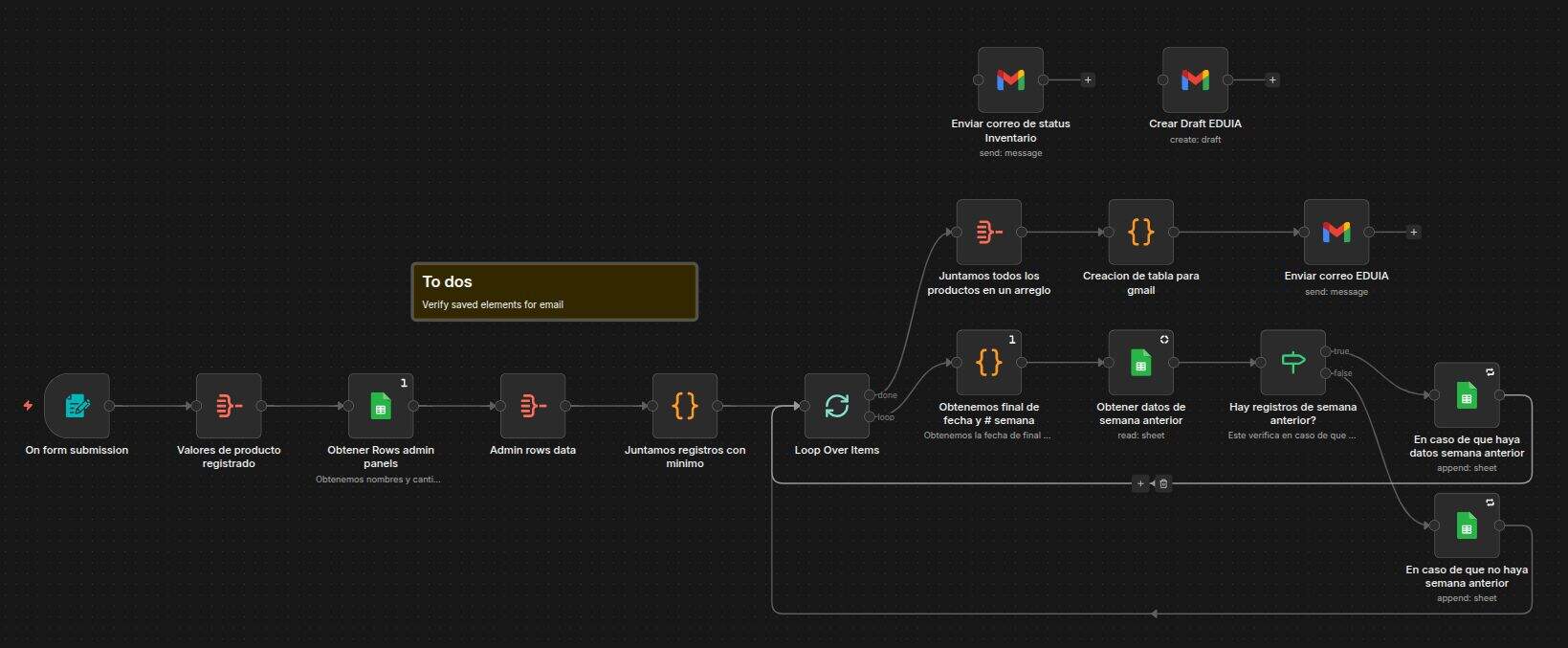
What We Built
Construimos un sistema determinístico en n8n que usa herramientas familiares:
- Google Forms como interfaz de entrada para el equipo de operaciones (sin curva de aprendizaje)
- Google Sheets como herramienta visual de state management el equipo ve el inventario en tiempo real
- Workflow n8n que compara automáticamente las entradas semanales contra baselines predefinidos
- Alertas automáticas cuando los niveles de inventario caen por debajo del umbral
- Sistema de procuración trigger que genera órdenes de compra automáticamente
Results
Sistema auto-sostenible que requiere cero mantenimiento técnico. El equipo de operaciones lo usa de forma independiente sin soporte de TI.
Eliminación completa del proceso manual de comparación de datos. Las alertas de procuración ahora son automáticas y precisas.
Adopción inmediata gracias a la interfaz familiar (Google Sheets/Forms). Sin entrenamiento extensivo necesario.
Tools & Technologies
- n8n Workflow Automation
- Google Sheets (State Management)
- Google Forms (Data Entry)
- Automated Alerts
- Deterministic Logic
Architecture Decisions
Why Google Sheets instead of a proper database? The operations team had zero technical background. They needed to see and edit inventory data in a familiar interface. Google Sheets provides real-time collaboration, version history, and conditional formatting out of the box. The n8n workflow treats Sheets as a visual state management layer, not a database. If they outgrow Sheets, the workflow can migrate to PostgreSQL without changing the business logic.
Why deterministic logic instead of AI? Inventory management is rule-based: if stock < threshold, trigger alert. There's no ambiguity that requires AI interpretation. Deterministic logic is 100% predictable, has zero operating cost, and never hallucinates. AI would add complexity and cost without adding value for this use case.
Why email alerts instead of a dashboard? The team checks email constantly but rarely opens dashboards. Email alerts ensure they see critical inventory issues immediately. The workflow sends different alert types: (1) Urgent: stock below minimum, (2) Warning: stock approaching threshold, (3) Weekly summary: inventory trends. This matches their existing communication patterns.
System Design
State management pattern: The Google Sheet has 4 sections: (1) Current inventory levels, updated automatically from form submissions, (2) Baseline thresholds, edited manually by the team, (3) Alert history, appended by the workflow, (4) Configuration, controlling alert frequency and recipients. This separation allows the team to adjust thresholds without touching the workflow logic.
Error handling: The workflow includes 3 layers of error handling: (1) Input validation to reject malformed form submissions, (2) Retry logic for transient Google API failures, (3) Fallback alerts if the workflow itself fails. This ensures the system degrades gracefully and the team is notified of any issues.
Cost Analysis
Operating cost: $0/month. The workflow runs on n8n's free tier (self-hosted on the same $20/month VPS as other workflows). Google Sheets and Forms are free. Email alerts use the existing Google Workspace subscription. There are no per-transaction costs or API fees.
Development cost: 2 weeks of work including requirements gathering, workflow design, testing, and documentation. The team spent 1 day learning the interface and providing feedback. Total investment: approximately $4,000 at $25/hour.
ROI calculation: Before automation, the operations team spent 5 hours per week manually comparing inventory levels against thresholds and sending alerts. At $20/hour, that's $100/week or $400/month in labor costs. The automated system eliminates this work entirely, paying for itself in 10 months. Additionally, the system catches stockouts 2-3 days earlier than manual monitoring, preventing an estimated $2,000/month in emergency procurement costs.
Scalability: The system currently handles 500 SKUs across 3 warehouses. The Google Sheet can handle 10,000+ rows before performance degrades. When the team reaches that limit, I'll migrate the backend to PostgreSQL while keeping the same Google Sheets interface, ensuring zero disruption to the operations team.